Frequently Asked Questions
Garage Door FAQs
Straight answers to the questions Erie County and Northeast Ohio homeowners ask most about broken springs, stalled openers, safety sensors, emergencies, and winter maintenance, all in one place.
24/7 emergency services
FAQ Hub
Every Question, One Place
Browse by topic or jump to a service area. Each group links back to its full page for more detail.
Don't see your question? Call and describe what your door is doing.
(814) 555-0198Erie Overhead Door FAQ
Erie, PA overview → What should I do if my garage door won't open and my car is trapped?
First, inspect the area around the door for physical obstructions and ensure the opener power cord is plugged in. Check the red emergency release cord hanging from the opener trolley. If you pull it to disengage the opener, attempt to lift the door manually only if the springs are intact. If a spring is snapped or cables are slack, do not attempt to force the door open, as an unbalanced door can drop suddenly and cause severe injury. Call our dispatch line immediately for priority technician assistance.
Why do garage door springs break more often during Erie winters?
Erie experiences intense lake-effect freezes and sustained sub-zero temperatures. Cold weather causes high-carbon spring steel to contract, lose flexibility, and become brittle. When an opener exerts sudden lifting torque on frozen, brittle steel, high-tension springs frequently fracture. Routine cold-weather inspection and appropriate lubrication help mitigate winter steel fatigue.
Can I replace a broken torsion spring myself?
Torsion springs operate under extreme mechanical tension capable of generating hundreds of foot-pounds of torque. Attempting DIY spring replacement without specialized winding bars, proper shaft fixtures, and professional mechanical training carries significant risk of serious injury, lacerations, or structural damage. We strongly recommend having an experienced independent contractor handle all spring balancing.
How do I know if my problem is the opener motor or the door itself?
You can perform a simple balance test by pulling the emergency disconnect cord when the door is fully closed. Attempt to manually lift the door halfway along its track. If the door moves smoothly and remains suspended at mid-height, the springs and tracks are balanced, suggesting the issue lies in the opener motor, drive belt, or logic board. If the door feels excessively heavy or binds in the tracks, the mechanical system requires adjustment.
What causes garage doors in Erie to squeak or grind loudly?
Persistent grinding or screeching typically stems from unlubricated steel rollers, dry torsion bearings, worn motor gears, or track misalignment exacerbated by lake moisture corrosion. Applying high-grade silicone-based garage lubricant to rollers, hinges, and springs can quiet minor friction, but grinding often indicates worn bearings that require professional replacement.
Garage Door Repair FAQs
Garage Door Repair page → Why did my garage door suddenly make a loud gunshot-like sound?
A loud bang inside an attached or detached garage almost always indicates a fractured torsion spring. Torsion springs hold immense mechanical tension to counterbalance the 150- to 300-pound weight of your door. When the steel coil snaps under fatigue, the stored kinetic energy releases instantly with a loud crack. Do not attempt to operate the electric opener once this occurs.
Can I open my garage door if only one cable has come off the drum?
Never attempt to open a garage door with a loose or disconnected lift cable. The cable transfers lifting tension from the torsion spring to the bottom fixture of the door. When one cable slips off the grooved aluminum drum, the door becomes lopsided. Forcing it to move will wedge the rollers inside the tracks, potentially bending horizontal rails or causing the entire door to crash down.
What causes garage door tracks to bend or misalign in Erie?
Track distortion often occurs from accidental vehicle bumpers, foundation shifting due to winter freeze-thaw cycles, or loose wall mounting brackets vibrating over time. Additionally, in Erie, moisture and slush brought in from snowy roadways can corrode the lower track jamb brackets, weakening their anchor points into garage framing.
Should I replace both torsion springs if only one broke?
Yes. Garage door springs are rated for a specific lifespan—typically 10,000 to 20,000 mechanical cycles. Because both springs experience the exact same number of opening and closing cycles and identical weather conditions, the unbroken spring has endured the same metal fatigue and is likely on the verge of failing. Replacing both ensures balanced door tension.
Can damaged individual garage door panels be replaced without buying a new door?
In many cases, yes. If damage is limited to the bottom panel from backing into the door or bottom rust from winter slush, a technician can often source and install an individual matching panel section, provided the door manufacturer and model line are still active. If multiple intermediate sections are warped or the door model is obsolete, full replacement may be more practical.
Garage Door Opener FAQs
Opener Repair page → Why is my garage door opener motor humming, but the door won't move?
A humming motor without door movement usually indicates a stripped main drive gear inside the operator casing, a blown starting capacitor, or a physical mechanical lock/broken spring preventing door movement. If plastic nylon shavings (often white or grey dust) are visible beneath the motor housing, the drive gear has ground down and requires replacement.
How does cold Lake Erie weather affect garage door openers?
Extreme winter temperatures stiffen factory lubricant on the operator's screw or chain rail and within internal gearbox assemblies. As viscosity increases, the motor requires significantly more electrical amperage to cycle the door, often tripping internal thermal overload switches or causing electronic force margin limits to register a false obstruction.
Can a broken opener gear kit be replaced, or do I need a whole new motor?
In many instances, popular models from LiftMaster, Chamberlain, Sears Craftsman, and Genie can be restored simply by installing a new gear and sprocket assembly. If the primary motor windings, logic board, and chassis are in sound condition, gear replacement is a cost-effective alternative to complete unit replacement.
Why does my garage door opener reverse before touching the floor?
This symptom is most commonly caused by misaligned photoelectric safety eyes, sunlight reflecting directly into the receiver lens, or improper downward travel force limits. If the mechanical track experiences stiffness or binds at a certain height, the opener's safety logic detects resistance and automatically reverses to prevent crushing.
What is the difference between belt drive and chain drive openers?
Chain drive openers utilize a heavy metal bicycle-style chain to pull the trolley; they are durable and economical but transmit noticeable vibration into overhead joists. Belt drive openers use a steel-reinforced polyurethane belt, delivering smooth, whisper-quiet operation that is ideal for homes with living quarters directly above or adjacent to the garage.
Safety Sensor FAQs
Sensor Repair page → Why does my garage door only close if I hold the wall button down continuously?
This is a built-in UL 325 safety override feature. When the opener detects that the infrared safety sensors are disconnected, misaligned, or obstructed, it disables one-touch closing from remotes and wall buttons to prevent accidental crushing. Holding the hardwired wall button applies constant pressure override so you can secure your home while awaiting professional repair.
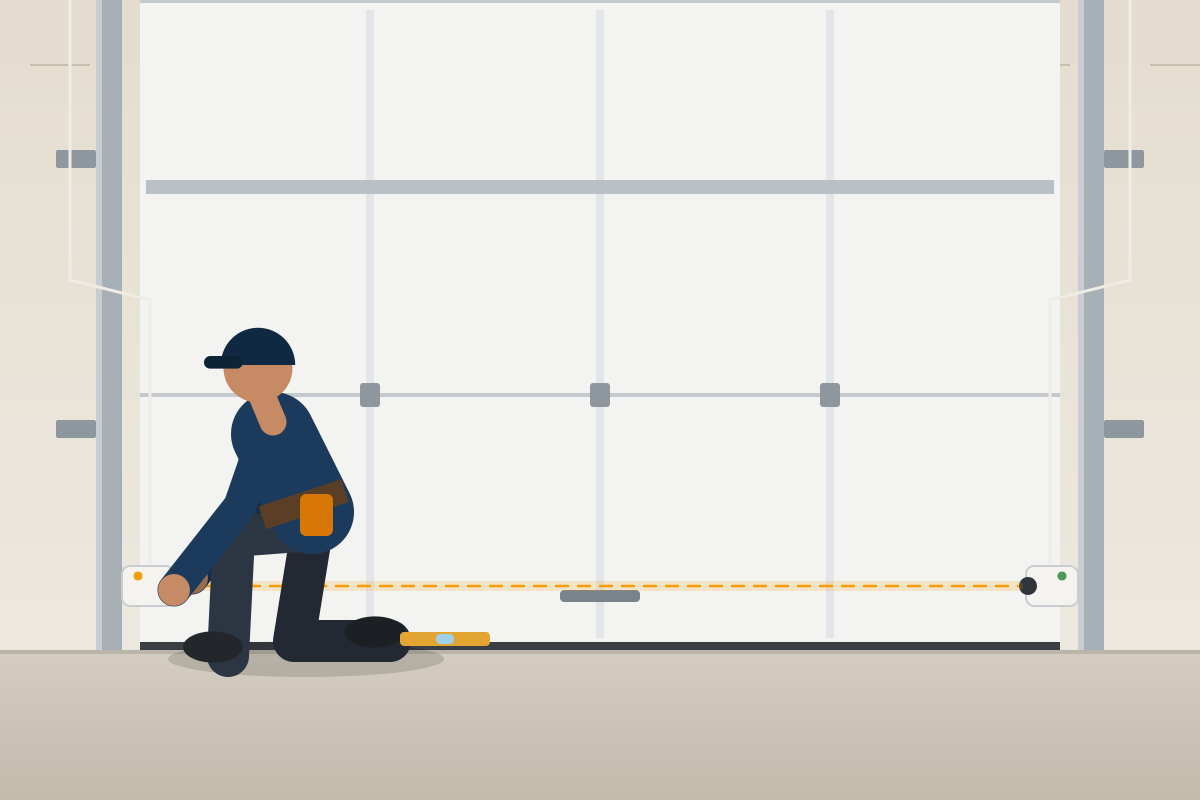
What do the different colored lights on my garage door sensors mean?
In most LiftMaster and Chamberlain systems, one sensor is the sending eye (typically featuring an amber or yellow LED) and the other is the receiving eye (typically green). A solid light on both units indicates healthy optical alignment. A flickering or unlit LED on the receiving sensor indicates an interrupted infrared beam, bracket misalignment, or damaged wiring.
How does Erie's winter weather interfere with safety sensors?
In Erie, blowing lake-effect snowdrifts frequently accumulate along the garage threshold, directly interrupting the invisible infrared beam positioned six inches above the ground. Furthermore, vehicle tires tracking in salty slush create high floor-level humidity, causing condensation or frost to fog the optical lenses, or corroding delicate wire splices located near baseboards.
Can direct sunlight cause garage door sensors to fail?
Yes. Low-angle morning or late-afternoon sunlight shines directly into the receiver lens with immense infrared intensity, blinding the optical sensor into interpreting the sun's rays as an obstruction. Technicians can solve this by swapping the positions of the sender and receiver units or installing anti-glare sun shields on the sensor housing.
Can I bypass or remove safety sensors entirely?
No. Federal safety regulations (UL 325) have mandated functional external entrapment protection devices on all automatic residential garage door openers manufactured since 1993. Bypassing or removing safety eyes creates a catastrophic crushing hazard for children and pets and represents a severe legal and insurance liability.
Emergency Garage Door FAQs
Emergency Repair page → My car is trapped inside the garage because the door won't open. Can you help?
Yes. Trapped vehicles are one of the most common urgent dispatch calls we handle. Our coordinator will prioritize routing an independent technician to your location to safely relieve mechanical tension, evaluate the counterbalance system, and open the door without causing further damage to your car or garage structure.
A car backed into our garage door and the panels are bent. Is it safe to touch?
Do not attempt to push, pull, or operate a garage door that has suffered an impact. Vehicle collisions frequently knock steel rollers out of the tracks while the high-tension counterbalance springs remain wound. The door is under extreme mechanical stress and can buckle or drop suddenly. Keep people away and call for urgent technician containment.
Why is a broken garage door an urgent emergency during Erie winters?
In northwestern Pennsylvania, a garage door stuck wide open during a winter blizzard exposes your home to sub-freezing temperatures within minutes. Attached garages frequently house water heaters, main water supply lines, laundry plumbing, and interior entry doors. Rapid heat loss can freeze and burst domestic water pipes, turning a door problem into catastrophic structural water damage.
Can I cut the cables if my garage door is jammed cockeyed in the track?
Under no circumstances should you ever cut, unbolt, or tamper with garage door lifting cables. Cables are directly attached to high-tension torsion springs winding hundreds of pounds of rotational force. Cutting a taut cable can cause the spring to violently unravel or send severed steel wire whipping through the garage, creating fatal hazard conditions.
How does priority dispatch handle severe winter storm calls?
During major Lake Erie snowstorms or severe freeze events, dispatch priority is assigned to critical safety situations: trapped emergency vehicles, doors hanging dangerously off overhead tracks, and homes where exposed pipes face imminent freeze risk. Calling our direct line ensures your case details are logged and dispatched to the nearest available technician.
Garage Door Service FAQs
General Service page → What is included in a professional garage door service inspection?
A complete professional service covers a multi-point mechanical inspection: checking torsion spring cycle wear and balance, inspecting lifting cables for fraying, testing center bearing and end bearing plates, tightening all hinge and jamb bracket lag bolts, inspecting roller bearings, measuring track plumb and spacing, calibrating opener travel limits and safety reverse mechanisms, and applying specialized high-viscosity lubricants.
Why shouldn't I use standard WD-40 on my garage door tracks and rollers?
Standard WD-40 is a solvent and degreaser, not an effective long-term lubricant. Spraying it on garage door rollers or springs breaks down the existing protective grease. Furthermore, WD-40 leaves a sticky residue that attracts dust, road grit, and salt particles, accelerating roller friction and bearing failure. Professional technicians use specialized heavy-duty silicone or lithium sprays engineered for cold-weather garage mechanisms.
How often should an overhead garage door be serviced in Erie, PA?
Due to the intense freeze-thaw cycles and high humidity from Lake Erie, a thorough professional service inspection is recommended once every 12 to 18 months. Regular checkups identify subtle metal fatigue in springs and bearings before catastrophic failure leaves your car trapped during a winter freeze.
What are the benefits of upgrading from steel rollers to sealed nylon rollers?
Standard steel rollers without ball bearings create harsh metal-on-metal screeching and vibration within the track channels. Upgrading to high-cycle nylon rollers equipped with 11-to-13 sealed ball bearings dramatically reduces operating decibels by up to 75% while sealed ball races prevent lake moisture and road salt from gumming up the internal bearings.
How do I know if my garage door is properly balanced?
Disconnect the automatic opener by pulling the red release cord with the door closed. Manually lift the door to waist height (about 3 to 4 feet off the ground) and let go. A properly balanced door will remain stationary, suspended by its counterbalancing springs. If the door drops rapidly toward the floor or snaps upward toward the ceiling, your spring tension is miscalibrated and requires service.
Garage Door Maintenance FAQs
Maintenance page → Why does my garage door bottom seal freeze to the concrete driveway in Erie?
When snow and slush melt off vehicle undercarriages inside the garage, water pools beneath the bottom door panel. As nighttime temperatures plunge near Lake Erie, this standing water freezes solid, bonding the bottom rubber gasket directly to the porous concrete floor. Attempting to open the door with the electric opener while frozen can tear the rubber seal or strip the opener gears. Technicians install heavy-duty EPDM rubber seals and advise on silicon treatments to prevent adhesion.
How does professional garage door winterization protect against Erie blizzards?
Winterization involves inspecting and replacing brittle perimeter jamb seals to stop 30-to-40 mph lake-effect winds from forcing snowdrifts through the gaps. Technicians also clean dried grease from tracks, lubricate spring coils with cold-temp lubricants rated to minus 30 degrees Fahrenheit, and re-tension springs to compensate for steel contraction in freezing weather.
What type of lubricant should be applied during regular maintenance?
Specialized non-greasy silicone or lithium lubricants formulated specifically for overhead garage door components should be used. Heavy automotive grease or standard engine oil must be avoided because they attract grit, turn gummy in freezing weather, and cause rollers to slide rather than roll, wearing flat spots into the wheel surfaces.
Can proper maintenance extend the lifespan of my garage door springs?
Yes. Rust and lack of lubrication create friction between the tightly wound coils of a torsion spring. As the spring twists, coil-on-coil friction generates microscopic stress cracks. Regular maintenance coats the coils with protective anti-corrosive lubricants, reducing rotational friction and helping the spring reach or exceed its rated cycle life.
How can I tell if my perimeter weatherstripping needs replacement?
Close your garage door during daylight hours and turn off the interior garage lights. Stand inside and look around the perimeter jambs and top header. If you see light penetrating around the sides or bottom, or feel cold drafts blowing in, your vinyl seal has shrunk, stiffened, or cracked and is no longer providing an airtight thermal barrier.
Spring Repair & Replacement FAQs
Spring Repair & Replacement page → How can I tell that a garage door spring has broken?
The most common sign is a loud bang from the garage, followed by a door that feels extremely heavy or will not lift more than a few inches. You may also see a visible gap in the coils of the spring above the door opening, or cables hanging slack. If you suspect a broken spring, stop using the opener and call a technician.
Can I replace a garage door spring myself?
No. Garage door springs are under enough tension to cause serious injury, and slipping winding bars are a leading cause of garage door injuries. Spring replacement should be done only by a trained technician with the correct tools, wire size and balance-testing equipment.
Why do garage door springs break more often in Erie winters?
Repeated lake-effect cold snaps make spring steel less forgiving, and every open-and-close cycle adds fatigue. Springs near the end of their cycle life often fail on the first very cold morning, when the opener asks them to lift a heavy door.
Should both springs be replaced if only one breaks?
On a two-spring door, the second spring has the same age and cycle count as the one that failed, so technicians commonly recommend replacing the pair together to keep the door balanced. Your technician will explain what they find on your specific door.
What is the difference between torsion and extension springs?
Torsion springs mount on a metal shaft above the door opening and twist to lift the door. Extension springs run along the horizontal tracks and stretch and contract. Torsion systems generally offer smoother, more controlled movement, while extension systems are common on older or lighter doors.
Commercial Overhead Door FAQs
Commercial Doors page → What types of commercial doors can be serviced?
Our network can help with overhead sectional doors, rolling (coiling) steel doors, and the commercial operators that open them, at shops, warehouses, storefronts and similar business properties. Loading dock equipment such as dock levelers is outside what we cover.
Can a commercial door be repaired, or does it need replacing?
It depends on the damage. Bent tracks, worn rollers, failed springs and operator faults are often repairable. A badly bent or buckled curtain or panel may be better replaced. A technician can inspect the door and explain the options.
Do you handle commercial door installation as well as repair?
Yes. Independent technicians connected through our service can install new commercial overhead and rolling doors, as well as replace worn-out units, subject to provider participation in your area.
Is emergency help available for a business door stuck open?
A door that cannot close leaves a business unsecured, so call dispatch right away. Same-day and 24/7 emergency services are subject to provider participation, location, technician availability and demand.
Why does a commercial door wear out faster than a residential one?
Business doors usually cycle many more times per day, are hit more often by vehicles and carts, and are frequently exposed to Erie's salt and slush. Regular inspection catches worn springs, rollers and safety devices before they fail.
Garage Door Installation FAQs
New Door Installation page → What happens to my old garage door during installation?
The technician removes the old door, tracks and hardware, installs the new door and matching hardware, and carries the old materials away unless you prefer otherwise. Ask your technician what is included before work begins.
Does a new garage door need a new opener?
Not always. A newer opener in good condition can often be reconnected to the new door. An older or noisy opener, or one lacking current safety features, may be worth replacing at the same time. Your technician will check compatibility.
Which garage door materials hold up best in Erie winters?
Insulated steel is popular because it resists dents, handles temperature swings well and needs little upkeep. Wood and composite doors offer a traditional look but need more care. A technician can talk through the trade-offs for your garage.
How long does a typical garage door installation take?
A standard single or double residential door is often a same-day project once the technician is on site, though custom sizes, framing repairs or opener changes can extend it. Scheduling depends on provider availability.
How do I know if I should repair or replace my door?
If the door is dented, rotting, out of balance in several places or repeatedly needing repairs, replacement may make sense. For a single worn part, repair is often enough. A technician can inspect the door and give you an honest assessment.
South Euclid Garage Door FAQs
South Euclid, OH page → How quickly can a technician respond to garage door repairs in South Euclid, OH?
Our dispatch coordinator routes calls directly to available independent technicians servicing South Euclid and eastern Cuyahoga County. When you call with an urgent issue—such as a broken spring or car trapped inside—we prioritize prompt local technician routing to restore your access quickly.
Why do detached garage slabs in South Euclid shift and cause door binding?
Many charming mid-century properties in South Euclid along Mayfield Road and Green Road feature detached garages built on concrete floating slabs. Heavy northern Ohio winter freeze-thaw cycles cause ground heave beneath the slab, slightly skewing the garage door framing. This shift pinches vertical tracks and causes door rollers to bind, requiring professional track releveling and balance adjustment.
Can older wooden or heavy composite doors in South Euclid be fitted with modern openers?
Yes. Many classic homes in South Euclid retain heavy architectural wood doors. Dispatched technicians evaluate door weight and spring counterbalance before recommending high-torque chain-drive or DC-motor belt-drive openers equipped with proper safety sensors and structural reinforcement brackets.
What are the common signs that my South Euclid garage door spring is failing?
Warning signs include the door feeling unusually heavy when lifted manually, visible gaps between coils on the torsion spring mounted above the door, squealing during operation, or the door opening only 4 to 6 inches before stopping.
Lakewood Garage Door FAQs
Lakewood, OH page → Why do detached garages in Lakewood require low-headroom track modifications?
Lakewood has some of the densest historic housing stock in Ohio, with many homes constructed between 1910 and 1940. Detached garages built during this era frequently feature low ceiling joists that lack the standard 12 to 15 inches of headroom required for modern overhead doors. Dispatched technicians specialize in dual-track low-headroom conversions and quick-turn brackets that allow doors to operate smoothly in tight spaces.
How does Lake Erie shoreline exposure affect garage doors in Lakewood?
Located directly along Lake Erie, Lakewood experiences constant onshore winds, high atmospheric humidity, and heavy lake-effect winter precipitation. This environment accelerates rust on steel torsion springs, lifting cables, and bottom track jamb brackets. Technicians recommend galvanized hardware, sealed nylon rollers, and corrosion-resistant springs for Lakewood properties.
Can a quiet belt-drive opener be installed in a garage located close to neighbors?
Yes. Due to Lakewood's narrow property lot lines where garages often sit feet away from adjacent neighbor's bedroom windows, quiet operation is essential. Upgrading from a noisy chain drive to a modern DC-powered belt-drive opener with soft-start and soft-stop technology significantly reduces sound transmission and mechanical vibration.
What should I do if my garage door jumps the track in a narrow Lakewood driveway?
Do not attempt to push or pull the door back into place. Narrow driveways make maneuvering around an unstable overhead door hazardous. Disengage the electrical power to prevent accidental activation and call our central dispatch line for priority technician arrival.
Rocky River Garage Door FAQs
Rocky River, OH page → Why do heavy architectural and carriage house doors in Rocky River need specialized spring balancing?
Many custom homes in Rocky River's Beach Cliff and Riverwood neighborhoods feature custom wood-faced or heavily insulated three-layer steel carriage doors. These assemblies can weigh 250 to 400 pounds. Counterbalancing such substantial mass requires precision-engineered dual torsion springs with calibrated wire gauges and heavy-duty center bearing plates to ensure smooth operation without straining the electric opener.
How does proximity to both Lake Erie and the Rocky River valley affect door hardware?
Rocky River properties experience dual microclimate moisture: dense fog and humidity rising from the river gorge alongside driving winter rain and snow off Lake Erie. This damp environment promotes surface rust on spring coils, hinges, and roller bearings. Technicians use marine-grade or heavy silicone lubricants and galvanized components to prevent premature metal deterioration.
What type of opener is best for custom architectural garage doors in Rocky River?
Direct-drive wall-mounted jackshaft openers (like the LiftMaster 8500 series) or DC-motor belt-drive units are preferred for upscale Rocky River residences. Wall-mounted openers mount beside the torsion bar rather than on ceiling joists, keeping overhead sightlines clean while delivering exceptional lifting torque for heavy insulated panels.
Can decorative strap hinges and handles be reinstalled after panel repairs?
Yes. When repairing or replacing damaged sections on carriage house doors, technicians carefully preserve and remount custom exterior decorative hardware, aligning all accents to maintain the original architectural character of your home.
North Ridgeville Garage Door FAQs
North Ridgeville, OH page → Why do builder-grade garage door springs in North Ridgeville break so quickly?
Many modern developments in North Ridgeville—such as Meadow Lakes and Waterbury—were constructed with standard builder-grade 10,000-cycle torsion springs. In active family homes where the garage door operates 4 to 8 times every day for commutes, school runs, and deliveries, 10,000 cycles are consumed in just 3 to 5 years. Dispatched technicians install high-cycle 20,000+ cycle replacement springs designed to double your hardware longevity.
How do open prairie crosswinds affect garage doors in North Ridgeville?
Located on relatively flat Lorain County terrain, North Ridgeville homes along Center Ridge and Sugar Ridge roads endure powerful westerly crosswinds. Wind pressure pushes against wide two-car double doors, bowing horizontal panels and flexing vertical track brackets. Technicians install heavy-gauge horizontal wind struts and reinforced jamb brackets to prevent wind damage.
Can a smart opener with smartphone monitoring be added to my existing door?
Yes. Independent technicians can install or retrofit Wi-Fi enabled smart openers (such as LiftMaster MyQ technology) to modern garage systems in North Ridgeville, allowing you to monitor open/closed status, receive push alerts, and operate your door remotely from anywhere.
What should I do if only one side of my three-car garage door won't open?
In three-car garages featuring a double door and a single third-stall door, each door has an independent counterbalance spring and motor assembly. If one door refuses to open, check for a broken spring on that specific torsion tube. Do not attempt to force the opener, as doing so can strip the nylon drive gears.
Elyria Garage Door FAQs
Elyria, OH page → What types of garage doors can be serviced in Elyria, OH?
Dispatched independent technicians service all residential and light-commercial overhead door styles across Elyria, including traditional sectional steel doors, insulated raised-panel models, custom wood doors in historic Eastern Heights, and rolling steel commercial shop doors throughout industrial corridors.
How does Black River humidity impact garage door tracks in Elyria?
The Black River valley creates persistent local humidity that condenses on cold steel overhead components inside garages. This moisture accelerates rust on track jamb brackets, hinge pins, and steel cable drums. Technicians apply specialized moisture-displacing silicone lubricants and install heavy-duty galvanized hardware to resist rust.
Why did my garage door cable snap on one side?
Overhead door cables are under constant high tension. Over years of use in Lorain County's damp climate, road salt and water cause the microscopic steel strands to oxidize and fray near the bottom bracket. Once enough strands weaken, the cable snaps under tension, causing the door to tilt violently.
Can older commercial and workshop garage doors in Elyria be repaired?
Yes. Many properties along Cleveland Street and Gulf Road feature oversized garage doors or light-industrial workshops. Technicians service heavy-duty torsion springs, commercial jackshaft openers, and 3-inch track systems.
Explore Our Regional Coverage & Specialty Services
Browse our overhead garage door repair capabilities across Erie County, PA and our regional service hubs in Northeast Ohio.
Overhead Door Services
- Garage Door Repair in Erie, PA
- Garage Door Opener Repair in Erie, PA
- Garage Door Sensor Repair & Alignment in Erie, PA
- Urgent & Emergency Garage Door Repair in Erie, PA
- Comprehensive Garage Door Service in Erie, PA
- Garage Door Maintenance & Winterization in Erie, PA
- Garage Door Spring Repair & Replacement in Erie, PA
- Commercial Garage Door Repair & Installation in Erie, PA
- Garage Door Installation & Replacement in Erie, PA
Regional Service Areas
- Erie, PA (Primary Hub & Erie County)
- South Euclid, OH Garage Door Repair
- Lakewood, OH Garage Door Repair
- Rocky River, OH Garage Door Repair
- North Ridgeville, OH Garage Door Repair
- Elyria, OH Garage Door Repair
Millcreek Township • Harborcreek • Fairview • Summit Township • Edinboro • Girard • North East • Waterford